LEN · Lenses
Telephoto Lens Techniques for Genuinely Sharp Shots
Telephoto lenses compress distance and isolate subjects. Learn the technique that separates sharp wildlife and sports shots from soft ones.
Diagrams
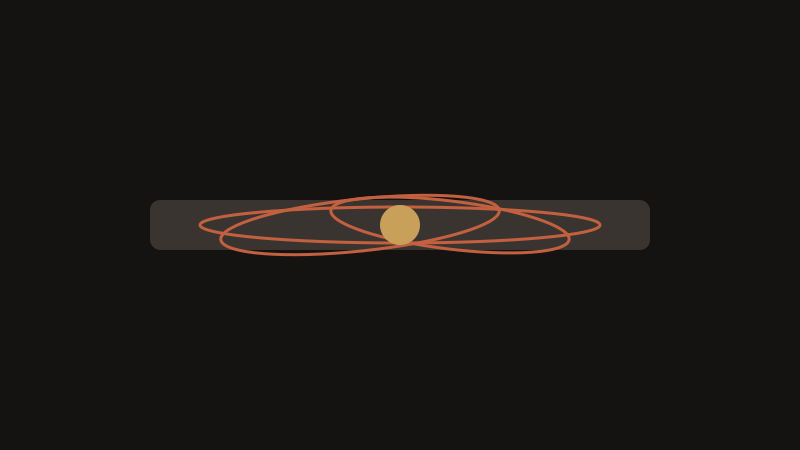
Telephoto generally means 85mm and up on full frame, with 70-200mm and 100-400mm the workhorses for sports, wildlife, and events. The optical signature is compression: a 200mm lens makes a distant mountain and a nearby tree look stacked, flattening depth in a way that flatters portraits and stacks urban skylines. The long focal length also narrows your field of view, so small camera movements become large framing shifts.
Shutter speed is the first problem. The old rule says shoot at 1/focal length or faster - 1/200s at 200mm - but that guideline assumed film-era sharpness standards. On a 24MP sensor, aim for at least 1/500s at 200mm and 1/1000s at 400mm for handheld work, or use image stabilisation and accept a lower hit rate. For birds in flight, 1/1600s to 1/3200s freezes wing beats. Raise ISO without guilt; a sharp ISO 3200 frame beats a blurred ISO 100 one.
Atmospheric haze and distance are the next enemies. Long lenses magnify haze, heat shimmer, and dust, which is why a 400mm shot across a hot parking lot looks flat and grey. Shoot early morning or after rain, keep the sun behind you, and use a lens hood - flare costs contrast fast on long glass. Focus technique matters too: use single-point AF on the eye, continuous AF for moving subjects, and back-button focus so the shutter does not refocus every frame.
Handholding a 2kg lens is a skill. Tuck your elbows in, support the lens with your left palm rather than the camera, exhale and squeeze the shutter. On a monopod or tripod, turn stabilisation off when the lens manual recommends it. And resist the urge to shoot everything at maximum zoom - 150mm at f/4 often gives a sharper, more usable frame than 400mm wide open.
Key points
- Telephoto starts around 85mm; 70-200mm and 100-400mm cover most sports and wildlife work.
- Handhold at 1/500s or faster at 200mm and 1/1000s at 400mm - the old 1/focal length rule is too loose for modern sensors.
- Haze and heat shimmer flatten long shots; shoot early, keep the sun behind you, and use a hood.
- Back-button focus with single-point AF on the eye keeps moving subjects sharp frame after frame.