LEN · Lenses
Prime vs Zoom Lenses: Which Should You Buy First?
Prime or zoom? This guide breaks down how each lens type changes your shooting, your budget and your images so you can choose the right one.
Diagrams
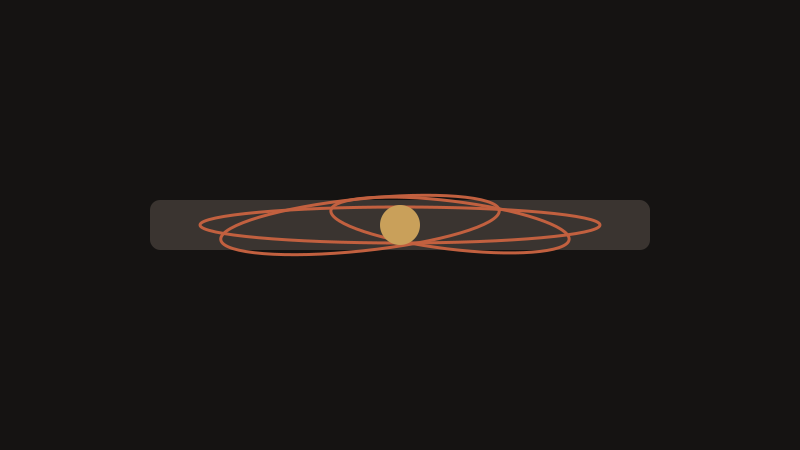
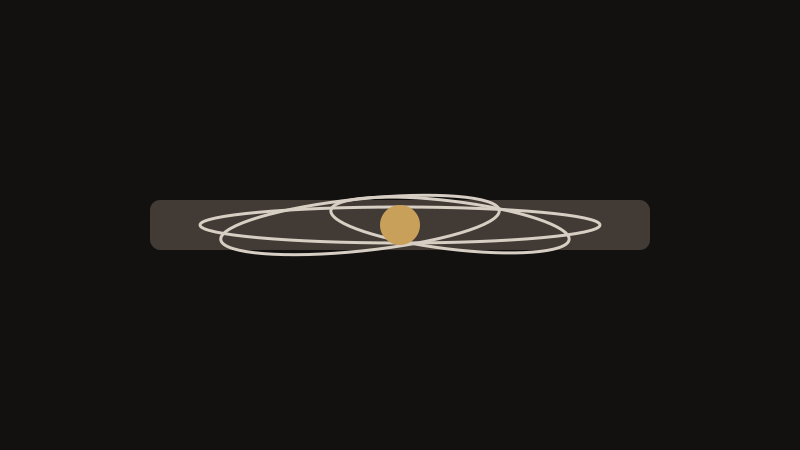
A prime lens has a single fixed focal length — 35mm, 50mm, 85mm — while a zoom covers a range such as 24-70mm or 70-200mm. The classic trade-off is that primes are usually sharper, smaller and faster (f/1.4 or f/1.8 versus f/2.8 or f/4), while zooms give you framing flexibility without moving your feet.
The decision matters most for a first or second lens, because that is where the money is tight and the habits are forming. What follows separates the trade-offs that actually show up in photographs from the ones that only appear on a specification sheet.
The Trade-Offs That Actually Matter
Four differences decide most purchases. Maximum aperture is the biggest, because it determines whether you can shoot in dim light without a tripod and whether the background can be thrown out of focus. Size and weight is the second, and it determines how often you actually carry the lens.
Framing flexibility is the third, and it is worth more than beginners expect in situations where you cannot move: an event, a crowd, a cliff edge. Cost is the fourth, and it is the reason the entry-level advice has stayed the same for decades.
Sharpness, the difference everyone talks about first, is the smallest of the four today. Modern zooms are far better than their 1990s reputation suggests, and at the apertures and print sizes most people use, the difference between a good zoom and a good prime is hard to see.
What a Prime Teaches You
The real gift of a prime is not optical, it is behavioural. With no zoom ring to turn, changing the framing means moving, and moving changes the relationship between your subject and its background. That single consequence teaches perspective faster than any article can.
The classic starter is a fast normal prime. On full frame, a 50mm f/1.8 is arguably the best value in photography: modest in cost, usable in dim indoor light at ISO 1600 instead of 6400, and capable of background blur that a kit zoom simply cannot produce. For a beginner on a crop-sensor body, a 35mm f/1.8 costs less than a mid-range zoom and gives a similar angle of view.
Specialist primes follow the same logic. Portrait shooters lean on 85mm f/1.8 or f/1.4 for flattering compression and subject separation, while street shooters use 28mm or 35mm primes for a discreet, lightweight walkaround kit.
Where a Zoom Earns Its Keep
Travel, event and wildlife photography reward flexibility, and there the zoom is not a compromise but the correct tool. A 24-105mm f/4 lets you shoot a wide establishing frame and then tighten to a head-and-shoulders shot in two seconds. You cannot back up across a cliff edge or down a crowded aisle.
Telephoto zooms such as 70-200mm f/2.8 and 100-400mm are close to mandatory for sports and birds, where the subject moves unpredictably and the distance is not negotiable. A prime may be sharper, but it is the wrong focal length the moment the bird turns.
Zooms also keep a camera bag small. One 24-105mm or 18-135mm replaces three or four primes, which matters when you are walking all day, travelling by air, or shooting somewhere that does not welcome a change of lens in the open.
Reading a Lens Spec Honestly
Two specification details cause more disappointment than any other. The first is variable maximum aperture: a 18-55mm f/3.5-5.6 is f/3.5 at the wide end and f/5.6 at the long end, so the light drops by more than a stop as you zoom in. That is why cheap kit zooms struggle indoors at the long end.
The second is the difference between a constant f/4 zoom and a constant f/2.8 zoom. The f/2.8 version is a stop brighter and usually heavier, larger and more expensive; the f/4 version is often the better buy unless you shoot indoors or need the extra subject separation.
Beyond that, look at focusing speed and minimum focus distance rather than chasing sharpness charts. A lens that focuses quickly and close is more useful in practice than one that wins a bench test at f/4 and hunts in low light.
Building a Two-Lens Kit
A practical path for most people is one kit zoom plus one fast prime: an 18-55mm or 24-105mm for flexibility, and a 35mm or 50mm f/1.8 for low light, blur and discipline. That pairing covers most learning situations and reveals which focal lengths you actually use.
The way to find out is to check your EXIF data after a month. If eight out of ten frames sit between 24mm and 35mm, your next lens is a wide prime rather than a telephoto, whatever you assumed at the start. Buying on what you photograph beats buying on what the specification sheet promises.
Avoid the common mistake of buying an f/2.8 zoom for bokeh. At the same framing, a far cheaper 50mm f/1.8 blurs the background more, because background blur depends mainly on aperture and subject distance rather than on how much the lens cost.
Key points
- Primes are typically sharper and faster; at the same framing an f/1.8 prime blurs the background more than an f/2.8 zoom.
- Start with one kit zoom plus one 35mm or 50mm f/1.8 prime, then check your EXIF after a month to see which focal lengths you really use.
- Zooms win wherever you cannot move: events, travel, sports, and wildlife.
- Do not buy an f/2.8 zoom for bokeh; a far cheaper 50mm f/1.8 gives stronger background blur.
Frequently asked questions
- Is a prime always sharper than a zoom?
Not always, and the gap is narrower than it used to be. Primes have a simpler optical design, so at the same price they usually have an advantage, and a good prime stopped down is very hard to beat. Modern constant-aperture zooms, however, are sharp enough that the difference rarely matters outside of large prints or close inspection.
- Should a beginner buy a 50mm f/1.8 first?
It is one of the safest first purchases, because it is inexpensive, light, and teaches low-light shooting and shallow depth of field immediately. On a crop-sensor body, a 35mm f/1.8 usually gives a more comfortable angle of view indoors, so check which sensor size you are buying for before choosing between the two.
- Is a 24-70mm f/2.8 worth it as a first lens?
It is an excellent lens for events, weddings and documentary work, where the light is unpredictable and you cannot move freely. As a first lens it is often more weight and cost than a beginner needs, and its f/2.8 maximum aperture produces less background blur than an inexpensive 50mm f/1.8 at the same framing.
- Do I need both a prime and a zoom?
Most photographers end up with both, because they solve different problems rather than competing. A common arrangement is a zoom for daylight, travel and events, and one fast prime for low light, portraits and days when you want to travel light. One lens and a clear idea beats a bag full of choices you never use.