LEN · Lenses
Focal Length Explained: What 16mm to 400mm Really Means
Focal length decides how much of the scene you capture and how it looks. This guide explains the 16mm to 400mm range in plain terms.
Diagrams
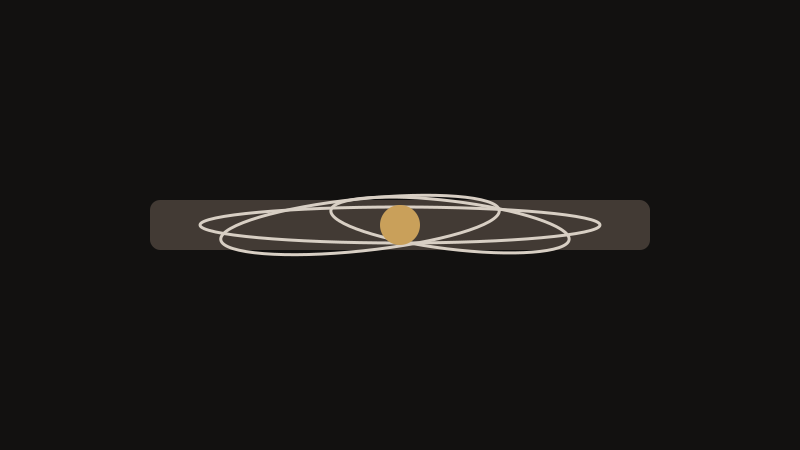
Focal length, measured in millimetres, is the distance from the lens's optical centre to the sensor when focused at infinity, but what matters practically is the angle of view it produces. On a 35mm full-frame sensor, roughly 50mm matches human perception, 35mm and below is wide, and 85mm and above is telephoto.
Two things change as the number rises: the field of view narrows, and distant subjects appear larger and more compressed. Everything else about choosing a focal length follows from those two consequences.
Angle of View, Not Just Millimetres
The millimetre figure is a physical measurement, but photographers choose focal lengths by what they show. A 24mm lens takes in a wide angle of view, around 84 degrees diagonally on full frame; a 200mm lens takes in about 12 degrees. That narrowing is the whole story of telephoto work.
Because the sensor size also affects the angle of view, the same lens behaves differently on different cameras. A 50mm lens on a crop-sensor body shows the same field of view as a 75mm lens on full frame, which is why the same lens can feel comfortable on one camera and cramped on another.
It helps to know two or three reference points by heart rather than all the numbers: roughly 24mm for a wide establishing view, 50mm for a natural view, and 85mm for a flattering portrait crop.
Walking the Range: 16mm to 400mm
16-24mm is ultra-wide: dramatic skies, interiors, tight landscapes, with strong perspective exaggeration at the edges. 28-35mm suits documentary and street, wide enough for context and close enough to human vision to avoid obvious distortion. 50mm is the classic normal lens, good for portraits and low light.
85-135mm flatters faces and is the portrait sweet spot, because the slight compression stops noses from growing and keeps the background soft. 200-400mm isolates distant subjects, compresses backgrounds into soft layers, and is standard for wildlife and sports.
The practical difference between adjacent ranges is smaller than the numbers suggest, and larger than beginners expect between distant ones. Moving from 35mm to 50mm changes little; moving from 50mm to 200mm changes the photograph completely.
Crop Factor and Equivalence
A 50mm lens on an APS-C body frames like roughly 75-80mm on full frame, using a factor of 1.5 or 1.6, and on Micro Four Thirds about 100mm, using a factor of 2. Beginners often find their 50mm too tight indoors on a crop body, where a 35mm is the full-frame 50mm equivalent.
Equivalence is useful for comparing fields of view, but it does not make a crop-sensor camera identical to a full-frame one. Depth of field differs at the same aperture, and low-light performance differs because the sensors collect different amounts of light in total.
Always check the sensor size before buying a focal length for a specific purpose. A lens described as wide on one system may be normal on another, and reviews written for full-frame cameras can be misleading if you shoot a smaller sensor.
Perspective Is Distance, Not Focal Length
Wide lenses distort is only half true. Distortion comes from standing close, and the wide lens simply lets you do it. Step back with a 24mm and faces look normal; the wide angle of view then shows more of the surroundings rather than stretching the subject.
This is why a wide lens and a telephoto lens can produce completely different pictures of the same subject from the same position only if you also change the lens's framing by cropping. For the same framing, you have to move, and moving is what changes perspective.
The practical consequence is that you can control perspective with your feet and control framing with the zoom. Photographers who understand this stop arguing about which focal length is correct, because the answer is that it depends on where you want to stand.
Choosing by Job, and the Single-Lens Exercise
Match the lens to the job: an ultra-wide for interiors and dramatic foregrounds, 35mm for documentary and travel, 50mm for low light and general use, 85mm for head-and-shoulders portraits, and a long telephoto for wildlife, sport and compressed landscapes.
The most practical exercise is to pick one focal length, say 35mm, shoot only that for a week, and learn how distance, not zoom, controls composition. It is uncomfortable for the first day and instructive for the rest of the week.
Zoom to frame; move to change perspective. Keeping those two actions separate, and noticing which one you are doing, is the fastest way to make focal length a deliberate choice rather than a habit.
Key points
- On full frame, 50mm is the normal view; below 35mm is wide, above 85mm is telephoto.
- Crop sensors multiply: 50mm on APS-C frames like roughly 75-80mm, and about 100mm on Micro Four Thirds.
- Wide-angle distortion comes from standing close, not from the lens itself - step back and it disappears.
- Shoot a single focal length for a week to learn how camera-to-subject distance, not zoom, shapes a photo.
Frequently asked questions
- Is 50mm really the same as the human eye?
It is a useful approximation rather than a fact. The human visual field is much wider than any single lens, but our attention is concentrated in the middle, and a 50mm lens on full frame roughly matches the size relationships we perceive when we look at a scene without scanning it. Many people find 35mm and 40mm equally natural, so treat 50mm as a convenient convention.
- What lens should I take travelling?
A standard zoom covering roughly 24-70mm or 24-105mm handles most travel subjects, from buildings to street scenes to people. Adding a small fast prime, such as a 35mm f/1.8, covers evenings and interiors. If one lens has to do everything, a zoom with a slightly wider range is usually more useful than a sharper prime you have to swap constantly.
- Why do my wide-angle shots look distorted?
Because you are standing very close to the nearest part of the scene, which makes it grow relative to everything behind it. That effect is a property of the distance, not the lens. Stepping back and cropping, keeping verticals parallel by holding the camera level, and avoiding placing faces near the frame edges will all reduce it.
- What focal length is best for portraits?
For head-and-shoulders framing, 85mm to 135mm on full frame is the classic range, because the slight compression is flattering and it keeps you far enough away that the subject is comfortable. Wider lenses work for environmental portraits, where the surroundings are part of the picture, but keep faces away from the very edges where distortion shows.