NHT · Night & Astro
Star Trails: Single Exposure vs Frame Stacking
How to capture the rotation of the night sky, and why stacking hundreds of short frames usually beats one very long exposure.
Diagrams

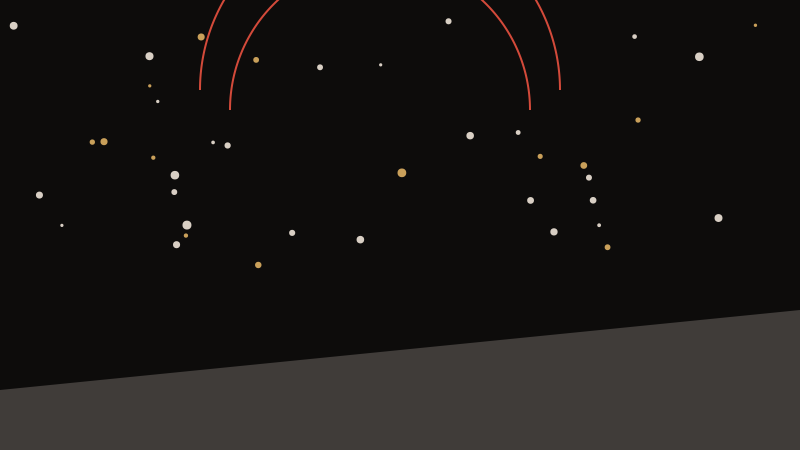

A star trail is simply the path the stars draw while the Earth turns. To make the arcs look circular rather than diagonal, point your camera at the celestial pole: Polaris in the northern hemisphere, Sigma Octantis in the south. The height of the pole above your horizon equals your latitude, so at 40 degrees north, Polaris sits about 40 degrees up. A wide, fast lens — 14mm to 24mm at f/2.8 — captures the whole swirl in one frame.
There are two ways to shoot trails. The single-exposure method uses Bulb mode with a remote that has a locking shutter: f/2.8, ISO 400 to 800, and 30 to 60 minutes in one go. It is simple, but a single car headlight, a passing plane or a hot pixel can ruin the entire frame, and the sensor heats up and produces noise. The stacking method is far more forgiving: take 200 to 400 frames of 20 to 30 seconds each at f/2.8 and ISO 1600, then blend them in software such as StarStax, Sequator or Photoshop's lighten blend mode. You can throw away the frames with aircraft or clouds and keep the rest.
For stacking, set the interval between frames to one second, or use the camera's built-in intervalometer. Any longer gap leaves a dotted, broken trail. Turn off long exposure noise reduction for sequences, because the camera's dark-frame pause also creates gaps. Lock the white balance and use fully manual exposure so the brightness stays consistent across the whole sequence.
Composition is what separates a technical exercise from a photograph. Include a foreground — a lone tree, a ruin, a lighthouse — and light-paint it briefly with a torch during the first or last frame. Check the moon: a bright moon washes out faint stars and turns the sky blue, so plan around the new moon for deep, dark skies, or deliberately use moonlight to reveal your foreground. The usual failures are a tripod sinking into soft ground, condensation fogging the front element (use a dew heater or hand warmers), and a battery dying halfway through a two-hour sequence.
Key points
- Aim at the celestial pole so the trails form circles: Polaris in the north, Sigma Octantis in the south.
- Stack 200 to 400 frames of 20 to 30 seconds at f/2.8 and ISO 1600 instead of one 30 to 60 minute exposure.
- Keep the interval between frames to one second and disable long exposure noise reduction, or the trail will be dotted.
- Add a foreground and light-paint it briefly, and check the moon phase before travelling to a dark site.